Scrum vs Traditional Project Management

Scrum certification: Scrum vs Traditional Project Management

Scrum vs Traditional Project Management

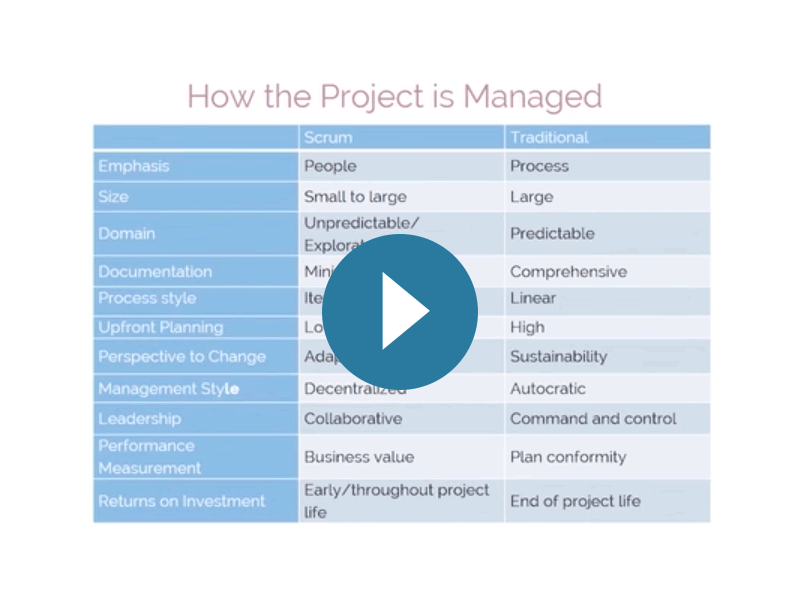
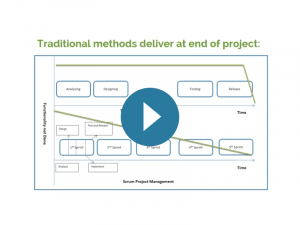
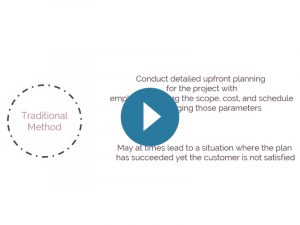
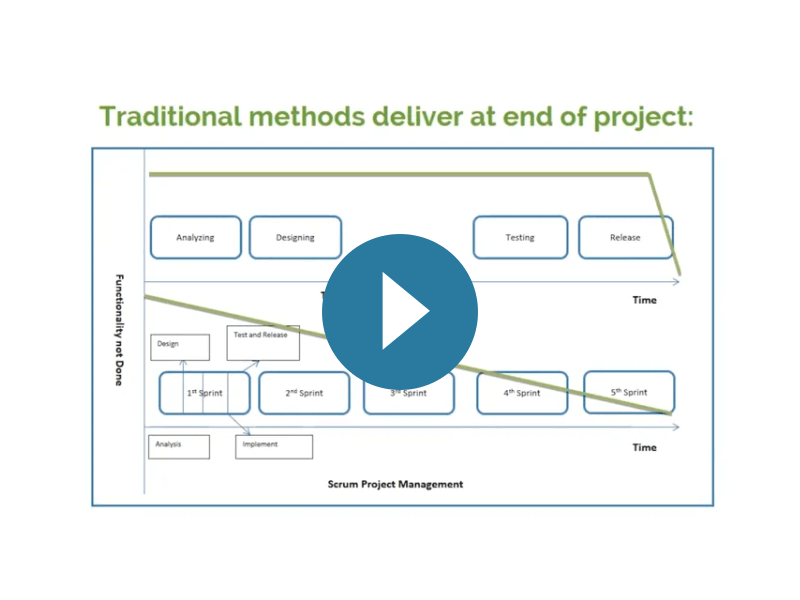
  • Scrum emphasis is on people, traditional project management’s emphasis is on processes. 
  • In Scrum, documentation is minimal – done only as required. In some traditional methods, it is very comprehensive – often not fit for the scale of the project. 
  • Scrum process style is iterative. Traditional is often more linear. 
  • In Scrum, upfront planning is low, traditional high.
  • In Scrum, prioritisation of requirements is based on business value and regularly updated. Traditional is fixed in the project plan. 
  • In Scrum quality assurance is customer centric. Traditional is more process centric. 
  • In Scrum organisation is self-organized. Traditional is ‘managed’. 
  • In Scrum, the management style is decentralized, traditional is centralized. 
  • In Scrum change normally includes updates to prioritised product backlog. Traditional normally goes through a formal change management system. 
  • In Scrum leadership is collaborative, servant leadership, vs traditional command and control. 
  • In Scrum performance measurement business value plan conformity, return on investment (ROI) early/throughout project life, vs traditional end of project life. 
  • In Scrum, the customer involvement is high throughout the project, traditional varies depending on the project lifecycle.

Video supplied by ScrumStudy: 2021® SCRUMstudy.com. All rights reserved.

SALE: was [woo_multi_currency_exchange price=’699′]

[woo_multi_currency_exchange price=’405′]

SALE: was [woo_multi_currency_exchange price=’310′]

[woo_multi_currency_exchange price=’99’]

Why use Scrum

Scrum certification: Why use scrum

Why use Scrum

Some of the key benefits of using Scrum in any project are:

  1. Adaptability: Empirical process control and iterative delivery make projects adaptable and open to incorporating change.
  2. Transparency: All information radiators like a Scrumboard and Sprint Burndown Chart are shared, leading to an open work environment. 
  3. Continuous Feedback: Continuous feedback is provided through the Conduct Daily Standup, and Demonstrate and Validate Sprint processes. 
  4. Continuous Improvement: The deliverables are improved progressively Sprint by Sprint, through the Groom Prioritised Product Backlog process. 
  5. Continuous Delivery of Value: Iterative processes enable the continuous delivery of value through the Ship Deliverables process as frequently as the customer requires. 
  6. Sustainable Pace: Scrum processes are designed such that the people involved can work at a sustainable pace that they can, in theory, continue indefinitely. 
  7. Early Delivery of High Value: The Create Prioritised Product Backlog process ensures that the highest value requirements of the customer are satisfied first. 
  8. Efficient Development Process: Time-boxing and minimising non-essential work leads to higher efficiency levels. 
  9. Motivation: The Conduct Daily Standup and Retrospect Sprint processes lead to greater levels of motivation among employees. 
  10. Faster Problem Resolution: Collaboration and colocation of cross-functional teams lead to faster problem solving. 
  11. Effective Deliverables: The Create Prioritised Product Backlog process and regular reviews after creating deliverables ensures effective deliverables to the customer. 
  12. Customer Centric: Emphasis on business value and having a collaborative approach to stakeholders ensures a customer-oriented framework. 
  13. High Trust Environment: Conduct Daily Standup and Retrospect Sprint processes promote transparency and collaboration, leading to a high trust work environment ensuring low friction among employees. 
  14. Collective Ownership: The Commit User Stories process allows team members to take ownership of the project and their work leading to better quality. 
  15. High Velocity: A collaborative framework enables highly skilled cross-functional teams to achieve their full potential and high velocity. 
  16. Innovative Environment: The Retrospect Sprint and Retrospect Project processes create an environment of introspection, learning, and adaptability leading to an innovative and creative work environment.

Video supplied by ScrumStudy: 2021® SCRUMstudy.com. All rights reserved.

History of Scrum

History of Scrum

In the mid 80’s, Hirotaka Takeuchi and Ikujiro Nonaka defined a flexible and all-inclusive product development strategy where the development team works as a unit to reach a common goal. They described an innovative approach to product development that they called a holistic or “rugby” approach, “where a team tries to go the distance as a unit, passing the ball back and forth.” They based their approach on manufacturing case studies from various industries.

Takeuchi and Nonaka proposed that product development should not be like a sequential relay race, but rather should be analogous to the game of rugby where the team works together, passing the ball back and forth as they move as a unit down the field. The rugby concept of a “Scrum” (where a group of players form together to restart the game) was introduced in this article to describe the authors’ proposal that product development should involve “moving the Scrum downfield”.

Ken Schwaber and Jeff Sutherland elaborated on the Scrum concept and its applicability to software development in a presentation at the Object-Oriented Programming, Systems, Languages & Applications (OOPSLA) conference held in 1995 in Austin, Texas. Since then, several Scrum practitioners, experts, and authors have continued to refine the Scrum conceptualization and framework. In recent years, Scrum has increased in popularity and is now the preferred project development approach for many organisations globally.
Video supplied by ScrumStudy: 2021® SCRUMstudy.com. All rights reserved.

Scrum Processes

Scrum Processes

Scrum Processes

Scrum processes address the specific activities and flow of a Scrum project. In total, there are 19 processes, which are grouped into 5 phases. These five phases describe each process in detail including the associated inputs, tools, and outputs.

Video supplied by ScrumStudy: 2021® SCRUMstudy.com. All rights reserved.

Scrum Aspects

Scrum Aspects

Scrum Aspects

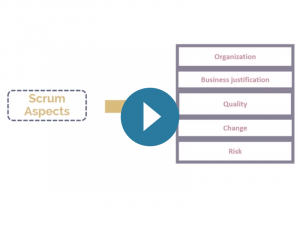
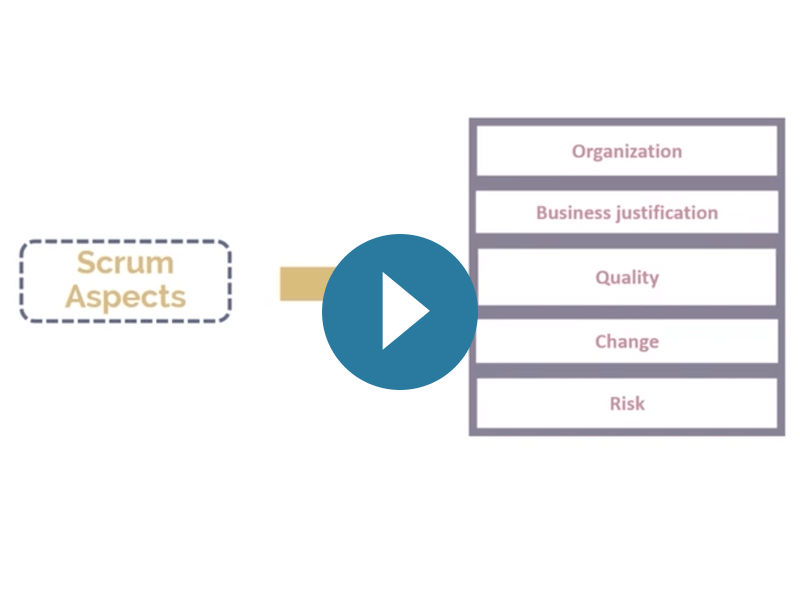
There are five Scrum aspects that must be addressed throughout any project, these are organization, business justification, quality, change, and risk.

  1. Organization:
    Understanding defined roles and responsibilities in a Scrum project is very important for ensuring the successful implementation of Scrum.
    Scrum roles fall into two broad categories:
  • Core Roles
    Core roles are mandatory and consist of the Product Owner, Scrum Master, and the Scrum Team.
  • Non-core Roles
    The Non-core Roles consist of Stakeholder(s), Scrum Guidance Body, and Vendors.
    Watch the Scrum Aspect: Organisation video.
  1. Business Justification:
    This aspect focuses on the concept and purpose of Business Justification as it relates to Scrum projects. 
    Watch the Scrum Aspect: Business Justification video.

  2. Quality:
    This aspect focuses on defining quality as it relates to projects and to present the Scrum approach to achieve the required levels of quality. 
    Watch the Scrum Aspect: Quality video.
  1. Change:
    This aspect focuses on the importance of change in any project, regardless of its method or framework, and expands on how Scrum development processes are designed to embrace change. 
    Watch the Scrum Aspect: Change video.

  2. Risk:
    This aspect focuses on the management of risks in a Scrum environment by considering various tools that facilitate the management of risks. 
    Watch the Scrum Aspect: Risk video.

Video supplied by ScrumStudy: 2021® SCRUMstudy.com. All rights reserved.

SALE was: [woo_multi_currency_exchange price=’905′]

[woo_multi_currency_exchange price=’610′]

[woo_multi_currency_exchange price=’310′]

[woo_multi_currency_exchange price=’110′]

Related courses
Related videos

Scrum Principles

Scrum Principles

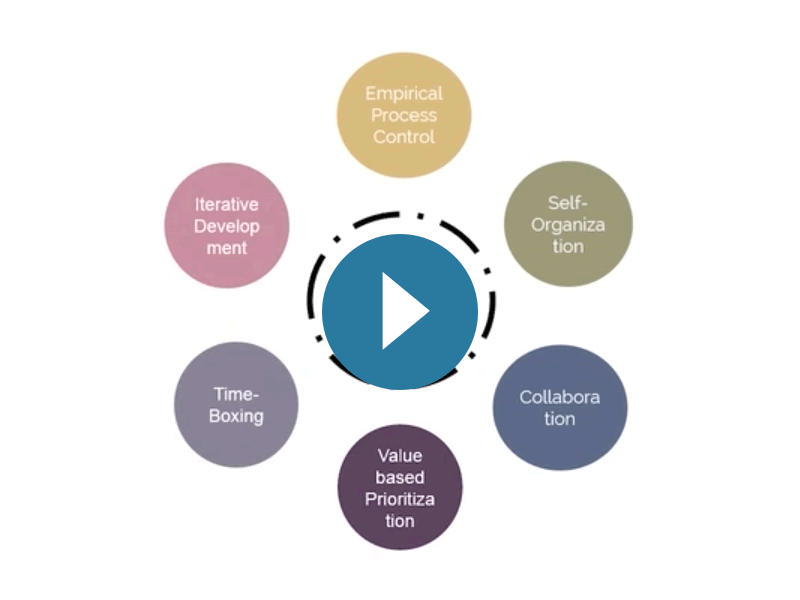
Scrum principles are the core guidelines for applying the Scrum Framework and should always be used in all Scrum projects. 

Video supplied by ScrumStudy: 2021® SCRUMstudy.com. All rights reserved.

Scrum Overview

Scrum Overview video

Scrum Overview

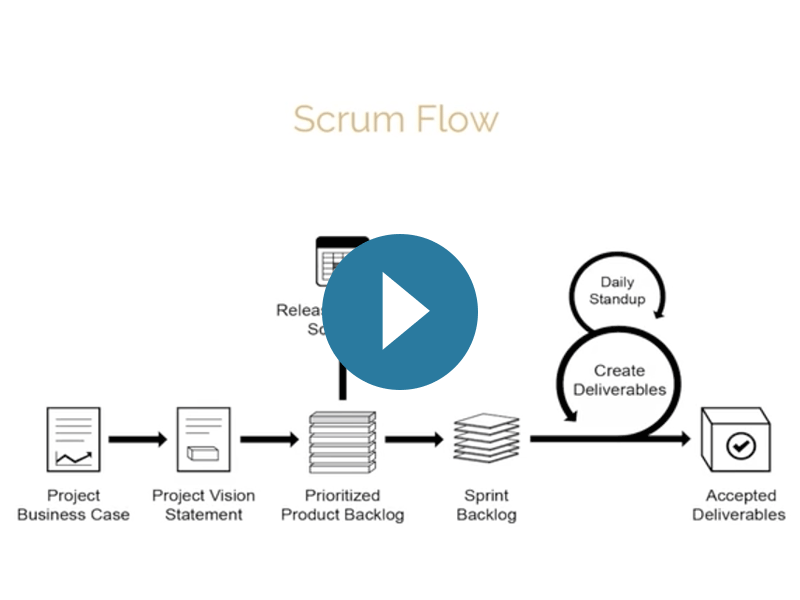
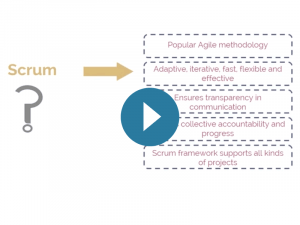
A Scrum project involves a collaborative effort to create a new product, service, or other result as defined in the Project Vision Statement. Scrum is one of the most popular Agile methodologies.

Video supplied by ScrumStudy: 2021® SCRUMstudy.com. All rights reserved.

Agile Methods

SCRUM Agile Methods

Agile Methods

A number of Agile approaches (methodologies / frameworks) originated and gained traction in the 1990’s and the early 2000’s. While they differ in a variety of aspects, their commonality stems from their adherence to The Agile Manifesto.

Video supplied by ScrumStudy: 2021® SCRUMstudy.com. All rights reserved.

error: Content is protected !!