

When a team is under pressure, recruitment can feel like the obvious answer. Advertise the role, find the right person and close the capability gap.
But what if the “right person” is difficult to find, or the work itself is changing faster than the position description?
Australia’s labour market is easing, but the capability challenge has not disappeared. The 2025 Jobs and Skills Australia Occupation Shortage List found that 29% of assessed occupations (293 out of 1,022) were in national shortage, down from 33% in 2024 and 36% in 2023. Recruitment has become easier in some areas, yet shortages remain concentrated in trades, health, education, construction and selected professional roles.
At the same time, organisations are asking more of the people they already employ. AI is reshaping tasks, operating models are changing and managers are expected to maintain performance while helping employees adapt. The result is a workforce question that cannot be answered by hiring alone:
The perfect candidate may not be coming, but your next capable manager may already be on the payroll.
Recruitment pressure is easing. Capability pressure is not.
The Australian HR Institute’s March 2026 Quarterly Australian Work Outlook surveyed 612 senior business decision-makers, including HR, from Australian organisations with two or more employees. Only 59% planned to recruit during the quarter, down from 71% in the previous quarter, while recruitment difficulties fell to 25% of recruiting employers.
However, 60% expected to increase skills investment over the following 12 months. The same AHRI research found that 36% of employers believed their leaders were not fully proficient in problem-solving, while 35% reported gaps in team development and 31% in people management. These are capabilities that directly affect how work is allocated, how change is communicated and whether performance issues are addressed early.
Gartner points to a similar change-readiness problem. In a July 2025 survey of 140 CHROs, 64% believed their leaders and managers lacked the mindset to lead change effectively. The public release does not specify the geographic composition of that survey, so it should be read as a broader CHRO indicator rather than an Australian workforce statistic.
Why frontline and middle managers are a high-leverage group
Managers sit where strategy becomes everyday work. They clarify expectations, delegate tasks, coach employees, resolve conflict, lead performance conversations and help teams respond to new systems, processes and priorities.
Gallup’s research attributes 70% of the variance in team engagement to the manager, reinforcing why frontline manager development can influence the employee experience far beyond one individual role. This does not mean training automatically creates productivity. A capable team still needs capable management. Clear expectations, useful feedback, recognition, development and good communication all influence whether people can do their best work.
This becomes even more important as AI changes jobs. Mercer’s Global Talent Trends 2026 draws on nearly 12,000 executives, HR leaders, employees and investors across 16 geographies and industries. Its Australian summary highlights work redesign, workforce planning and manager capability as important drivers of return on people investment, not simply technology adoption in isolation.
Perth and WA: Recruitment still matters, but it needs support
Western Australia provides a useful example of why this is not an “upskilling versus hiring” debate.
Jobs and Skills Australia recorded 26,300 online job advertisements in WA in May 2026. Frequently advertised occupations included electricians, metal fitters and machinists, motor mechanics, registered nurses and truck drivers. Employers in these areas will still need recruitment, migration, apprenticeships and training pipelines.
But hiring people into growing teams creates another requirement: enough capable supervisors and managers to set expectations, transfer knowledge, delegate safely, address performance concerns and keep projects moving.
In Perth-based operational, government, construction, resources, health and service environments, the pressure may not simply be “we need more people”. It may also be “we need existing leaders to manage expanding or changing teams more effectively”.
Five questions to ask before opening another vacancy
1. Is this a headcount gap or a capability gap?
A headcount problem means there is genuinely more work than the available people can handle. A capability problem means the people are present, but work is being slowed by unclear priorities, weak delegation, limited confidence or missing technical and management skills.
Before advertising, ask: If we improved the team’s current capability, would the vacancy still be required?
2. Has the role been redesigned for the work ahead?
Do not automatically replace yesterday’s position description. Identify which tasks will remain human-led, which may be automated or AI-assisted, and which new capabilities the team will need.
Gartner reports that organisations are already redefining roles, redeploying employees and changing skill requirements in response to AI. Workforce planning should therefore examine the work before defaulting to like-for-like replacement.
3. Where is the hidden internal candidate?
A skills-based review can reveal employees with transferable experience who may not follow the traditional career path for a role. WTW argues that clearer skills visibility and internal mobility can help organisations identify capability gaps, retain institutional knowledge and make better use of existing talent.
This is especially relevant when external mobility is lower. AHRI’s September 2026 research suggests employers should consider job rotation, redeployment, training and clearer career pathways to keep employees developing when experienced talent is harder to attract externally.
4. Are you developing managers for the conversations they face?
Generic “leadership awareness” is rarely enough. Prioritise observable workplace practices, such as:
- setting clear expectations
- delegating without losing accountability
- coaching rather than immediately solving every problem
- giving constructive feedback
- managing conflict early
- communicating change consistently
- connecting team priorities to operational and project outcomes.
5. How will you know behaviour has changed?
Attendance and satisfaction are useful, but they are not workplace impact measures.
Ask managers to nominate one or two behaviours they will apply, then review progress with their leader after 30, 60 and 90 days. Look for evidence such as clearer task ownership, better-quality performance conversations, earlier issue resolution, reduced rework or more consistent project follow-through.
How ATI-Mirage can help: A focused manager capability pathway
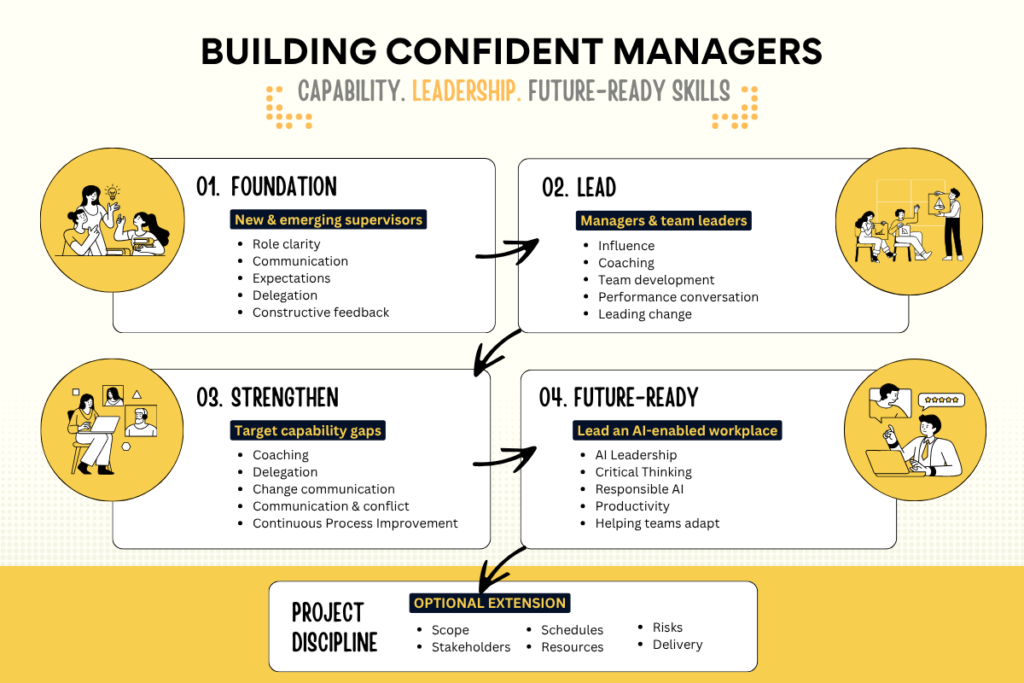
Rather than selecting from a broad catalogue, organisations can build a targeted pathway around the manager’s current responsibilities:
- Build the foundation: Supervisor Toolkit for new and emerging supervisors. This course covers expectations, communication, delegation, problem-solving, feedback and performance monitoring.
- Strengthen leadership and performance: Leadership Essentials, Leading Me, Leading Others or Managing People and Performance for managers who need greater confidence in coaching, influence, performance conversations, team development and leading change.
- Target the pressure points: Add Coaching for Performance, Mastering Delegation, Leading & Communicating Change or practical communication and conflict training where the capability diagnosis shows the greatest need.
- Prepare managers for AI-enabled work: Add Leadership in the Age of AI, AI: Benefits, Risks & Ethics, Critical Thinking in the Age of AI or The AI-Enabled Manager as an optional extension for managers responsible for introducing AI, improving productivity or helping teams adapt.
Project Management can then be added as a secondary extension for managers responsible for scope, stakeholders, schedules, risks and delivery, not as a substitute for people-leadership capability.
The following pathway illustrates how those elements can work together.
Build before you buy, but keep both options open
External recruitment will always matter. New people bring capacity, specialist expertise and different perspectives.
The smarter question is not “Should we hire or train?”
It is: “What combination of hiring, internal mobility, role redesign and manager development will give us the capability we need?”
Organisations that ask that question early are less likely to wait indefinitely for a perfect candidate, and more likely to recognise the potential already inside their workforce.
Build capability from within! Contact ATI-Mirage about a leadership, communication or project-skills pathway for you and your team.